
Is an NRSP loan right for you?
Not long ago, a client from Okara asked me, “Can I really get a tractor loan from NRSP without a bank account?” That question captures the confusion I see almost daily. Farmers, small shopkeepers, women stitching from home – they all type “NRSP loan details” into Google hoping for a clear answer, but what they find is usually scattered brochures, old news, or generic advice that doesn’t match their reality.
I’ve spent years helping people understand how National Rural Support Programme financing actually works. What I’ve found is that the gaps in information are huge. Many applicants misunderstand eligibility, miscalculate installments, or apply for the wrong type of financing altogether. This isn’t just about a loan – it’s about avoiding a debt trap while building something that lasts.
In this guide, I’m going to walk you through every NRSP loan detail that matters before you fill out a single form. You’ll see real examples, sample installment plans, comparison tables, and the exact steps to apply – all written in plain English, the way I’d explain it if you were sitting across the table from me. By the time you finish, you’ll know whether an NRSP financing scheme fits your life, how to choose the right product, and how to sidestep the mistakes that trip up most first-time borrowers.
What Is an National Rural Support Programme Loan?
The first thing you need to understand is that NRSP is not a traditional bank. I’ve noticed that many people search for “nrsp bank loan” or assume it’s a government bank. Let me unpack that.
Is NRSP a bank or development program?
NRSP – the National Rural Support Programme – is a not-for-profit development organization that runs one of Pakistan’s largest microfinance operations. Over time, it established a regulated microfinance bank (NRSP Microfinance Bank) to handle lending.
So when you apply for an NRSP loan, you’re essentially dealing with a specialized microfinance institution that follows State Bank of Pakistan regulations but is designed for rural and low-income communities.
It’s not a commercial bank like HBL or UBL, and it doesn’t offer regular current accounts the way banks do – it focuses sharply on micro-credit and agricultural financing.
Pro Tip: Don’t get hung up on the word “bank.” Think of NRSP as a community-first lending platform. That mindset shift will help you understand why their documentation, collateral rules, and turnaround times are different from what a traditional bank demands.
How NRSP loans work
At its core, an NRSP loan scheme provides small to medium-sized loans – usually between PKR 20,000 and PKR 500,000 – to individuals, farmers, and micro-entrepreneurs who may not have access to formal banking.
The model relies heavily on group lending and social collateral: you may need to form or join a community group, and the group’s collective responsibility often replaces physical collateral.
Disbursement can happen in cash, through a bank account, or sometimes directly to a supplier (especially for tractor and input loans). Repayments are structured in equal monthly installments, with markup (profit) built into the schedule.
The whole process is supervised by loan officers who work in the field, meaning someone will likely visit your home or business before approval.
Who NRSP financing is designed for?
This isn’t a one-size-fits-all program. NRSP financing is designed mainly for:
- Smallholder farmers who need crop inputs or a tractor,
- Rural women running home-based stitching or dairy businesses,
- Micro-entrepreneurs like vegetable vendors or kiryana store owners,
- First-time borrowers who cannot meet conventional bank requirements.
If you’re a salaried person in a city looking for a personal loan, this probably isn’t for you. But if you belong to a rural community with a viable income-generating activity, the NRSP loan details you’re about to read will feel very relevant.
Types of NRSP Loans Available
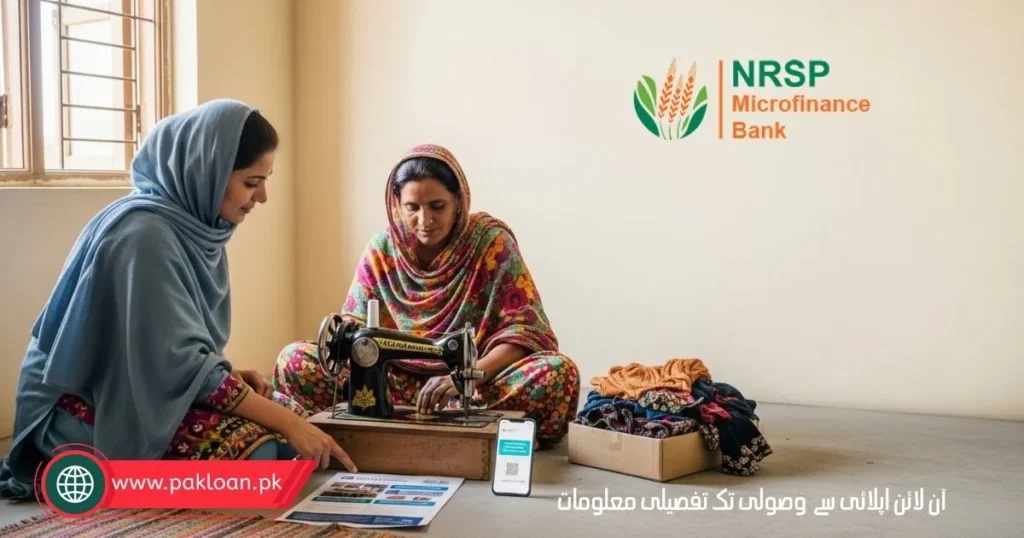
One of the biggest reasons applications fail is that people pick the wrong product. I’ve reviewed hundreds of cases where a farmer applied for a general micro-credit loan instead of the agriculture-specific scheme and got rejected for “purpose mismatch.” Below, I’ve broken down every major loan type with a quick-reference table.
Microfinance / small business loans
This is the most common NRSP loan category. It serves daily-wage earners, small shopkeepers, and women engaged in stitching, embroidery, or food businesses. Loan amounts usually start from PKR 20,000 and can go up to PKR 200,000 (sometimes more for repeat borrowers). The typical tenure is 6 to 18 months, and weekly or monthly installments are common.
You may also like: Step-by-Step Guide on how to apply for Small business loans in Pakistan
NRSP agriculture loan
The nrsp agriculture loan is tailored for seasonal crop inputs: seeds, fertilizers, pesticides, and small irrigation equipment. It follows the crop cycle, so repayment often aligns with harvest. Farmers get a lump sum at the start of the season and repay in a bullet or semi-annual structure, depending on the area. Tenures are usually 6 to 12 months, and the loan size depends on acreage and crop type.
You may also like: Step-by-step Guide to Interest Free agriculture loan in Pakistan
NRSP tractor loan
Perhaps the most searched variant online is the “nrsp bank tractor loan.” NRSP facilitates tractor financing – often in partnership with the government’s agricultural development schemes – covering up to 80% of the tractor’s cost. Borrowers need to contribute a 20% down payment and provide a guarantor. Repayment spans 3 to 5 years in quarterly or half-yearly installments. This is a game-changer for small landholders who want to stop renting tractors.
Livelihood and enterprise financing
This broader category covers dairy, poultry, fisheries, and even small manufacturing units. Loans are typically larger (up to PKR 500,000 in many cases) and come with slightly longer tenures of 12 to 24 months. The idea is to help rural families build a sustainable source of income beyond subsistence farming.
| Loan Type | Typical Amount (PKR) | Repayment Tenure |
|---|---|---|
| Microfinance / Small Business Loan | 20,000 – 200,000 | 6 – 18 Months |
| NRSP Agriculture Loan | 30,000 – 150,000 | 6 – 12 Months |
| NRSP Tractor Loan | 300,000 – 1,200,000 | 3 – 5 Years |
| Livelihood & Enterprise Financing | 50,000 – 500,000 | 12 – 24 Months |
I always advise people to sit down and match their actual need with one of these buckets before they even start collecting documents. That small step alone can dramatically lift your approval chances.
Pro Tip: If you’re a farmer needing both crop inputs and a tractor, apply for the agriculture loan first and establish a strong repayment history. Then approach the tractor financing later. NRSP looks at your repayment behaviour across products - a clean record opens doors.
NRSP Loan Eligibility Criteria
Knowing the NRSP loan eligibility rules is like reading the answer sheet before an exam. I’ve seen too many borrowers rush to apply without checking the basics, only to face rejection.
Income requirements
There’s no fixed minimum income figure publicly advertised – NRSP assesses your repayment capacity rather than a rigid number. However, in my experience, you need to show a stable stream of income from farming, a micro-business, or livestock. For a PKR 50,000 loan, weekly earnings of PKR 2,500 – 3,000 can be enough if your household expenses are low. The loan officer will calculate your surplus income after deducting living costs.
Guarantor / collateral requirements
Group lending is the backbone of NRSP microfinance. You’ll likely need to be part of a community group where members cross-guarantee each other. For larger loans, especially tractor financing, a personal guarantor (often a land-owning family member) and hypothecation of the asset (the tractor itself) are required. Physical collateral like gold or property is rare – that’s a major plus for rural applicants.
Documentation needed
The checklist is simpler than a bank’s, but missing documents remain a leading cause of rejection. Typical documents include:
- Valid CNIC (computerized national identity card),
- Recent passport-size photographs,
- Proof of residence (utility bill or a letter from the local councillor),
- Business or farm proof (land deed, rent agreement, or reference from the community),
For group loans: group registration form and meeting minutes.
Who may not qualify
NRSP financing isn’t for everyone. You may be declined if you:
- Already have an overdue loan with any financial institution,
- Lack a clear source of income,
- Are below 18 or above 60 years (age limits vary by product),
- Intend to use the loan for unproductive expenses like weddings or medical bills,
- Live in an area where NRSP doesn’t have an active field unit.
Here’s a quick eligibility checklist to keep handy:
Eligibility Checklist:
- Resident in an area covered by NRSP operations
- Aged 18 – 60 years
- Valid CNIC and photographs
- Proof of stable income or farming activity
- Group membership or reliable guarantor
- No existing loan defaults
- Loan purpose aligns with an approved scheme
How to Apply for NRSP Loan Online (Step-by-Step)

A growing number of people now search for “nrsp online loan apply” or “nrsp loan apply online.” While the core of NRSP’s model is field-based, you can initiate the process digitally through the NRSP Microfinance Bank’s portal or app, saving you time and travel.
NRSP online loan apply process
If you want to apply online, start by visiting the official NRSP Microfinance Bank website or downloading their mobile app. Look for the “Apply for Loan” option. You’ll fill in basic personal details, loan purpose, and the amount you need. Some products also allow you to upload scanned documents.
That digital step isn’t the whole journey – it’s essentially a lead generation tool. Within a few days, a loan officer from the nearest field unit contacts you to schedule a visit. I’ve seen this hybrid approach work well because it combines the convenience of online inquiry with the personal verification NRSP trusts.
Documents required
Whether you apply online or offline, you need the same set of documents:
- CNIC copy,
- Two passport-size photos,
- Residence proof (utility bill or letter),
- Farming or business evidence,
- Any co-applicant/guarantor documents for larger loans.
Verification and approval process
After your initial request, a loan officer visits your home or business. They’ll interview you, your group members, and maybe your neighbours. They’re assessing character, repayment capacity, and the genuineness of your purpose. The officer then prepares a report that goes to the branch credit committee for approval.
How long approval takes
For microfinance and agriculture loans, the whole process – from application to disbursement – usually takes 2 to 3 weeks if all documents are in order. Tractor loans may take 4 to 6 weeks because of additional documentation and coordination with tractor dealers. I always tell applicants to factor in this timeline and not expect instant cash.
Step-by-Step Framework:
- Identify the right loan type using the table above.
- Gather all required documents and scan clear copies.
- If applying online, fill the inquiry form on the official portal.
- Answer the loan officer’s call and schedule a field visit.
- During the visit, be transparent about your income and purpose.
- Wait for the credit committee’s decision (usually within a week after the visit).
- Upon approval, sign the loan agreement and collect the disbursement.
Pro Tip: During the field officer’s visit, show them your business in action. Let them see your shop, your crops, or your livestock. Real-world evidence of activity dramatically strengthens your application more than any piece of paper.
NRSP Loan Calculator – Estimate Your Installments
Before you apply, you must understand the numbers. I wish every potential borrower used an “nrsp loan calculator” or at least did a rough mental estimation. Too often, people accept the first figure they’re told without checking if the installments fit their monthly cash.
How installment calculations work
NRSP loans typically use the declining balance method – meaning markup is calculated on the outstanding principal, not the original loan amount. This makes the effective cost lower than a flat-rate loan.
The official nrsp loan calculator (available on NRSP Microfinance Bank’s website or through loan officers) computes your monthly installment based on loan amount, tenure, and the applicable profit rate.
That being said, you don’t need to be a math whiz. Understanding a couple of sample cases will give you a huge advantage.
Sample repayment examples
Let’s walk through two real-world scenarios that illustrate the installment burden.
Example 1:

PKR 50,000 microfinance loan at 22% annual declining markup over 12 months.
Your monthly installment would be approximately PKR 4,700. Over one year, total repayment would be around PKR 56,400.
Example 2:

PKR 100,000 agriculture loan at 22% declining markup over 18 months.
Monthly installment comes to roughly PKR 6,600, with total repayment near PKR 118,800.
| Loan Amount (PKR) | Tenure | Monthly Installment | Total Repayment |
|---|---|---|---|
| 50,000 | 12 Months | PKR 4,700 | PKR 56,400 |
| 100,000 | 18 Months | PKR 6,600 | PKR 118,800 |
| 200,000 | 24 Months | PKR 10,400 | PKR 249,600 |
Note: These are illustrative; actual rates, insurance fees, and processing charges may vary slightly. Always confirm with an official repayment schedule.
Using an NRSP loan calculator
If math isn’t your thing, simply ask a loan officer to run the numbers for you using the official nrsp loan calculator. Force yourself to compare at least two tenure options – a longer tenure reduces monthly pressure but increases total markup. That trade-off is exactly what I want you to consider before signing.
Pro Tip: Write down your expected weekly or monthly income, subtract household expenses, and see if the installment comfortably fits within 50% of your surplus. If the installment eats up 80% of your free cash, you’re setting yourself up for stress - even if the loan is approved.
NRSP Agriculture Loan and Tractor Loan Explained

Given that a huge share of searches is around “nrsp agriculture loan” and “nrsp bank tractor loan,” this section is especially important for readers from rural Punjab, Sindh, and KP.
Who can apply
Agriculture loans target small and medium farmers who cultivate their own land or work as tenants with a documented agreement. For tractor loans, the typical requirement is ownership of at least 5 acres, a viable cropping plan, and a down payment of around 20% of the tractor’s price. I’ve seen cases where a group of small farmers jointly applied for a tractor under a shared agreement – NRSP is often flexible if the proposal makes financial sense.
Financing features
Agriculture loans: Quick disbursement at the start of the sowing season, with repayment aligned to harvest. Loan amounts often range PKR 30,000 to PKR 150,000, depending on the scale.
Tractor loans: Financing up to 80% of the vehicle cost, with the tractor itself acting as security. NRSP sometimes collaborates with the government’s Kissan package to offer a subsidized markup rate (as low as 12 – 15% in some schemes).
Repayment terms for farmers
For crop loans, farmers often repay in one or two lump sums after harvest. For tractor loans, the schedule is typically quarterly or half-yearly, spread over 3 to 5 years. This seasonal rhythm matches agricultural cash flows – that’s a big advantage over monthly bank loans that ignore the farming calendar.
| Feature | NRSP Agriculture Loan | NRSP Tractor Loan |
|---|---|---|
| Purpose | Crop inputs, irrigation support | Tractor purchase financing |
| Loan Amount | PKR 30,000 – 150,000 | PKR 300,000 – 1,200,000 |
| Collateral | Group guarantee / hypothecation | Tractor hypothecation + guarantor |
| Repayment | Seasonal (harvest-linked) | Quarterly / Half-yearly (3–5 years) |
| Markup Rate | 20–24% p.a. (declining) | 12–18% p.a. (scheme dependent) |
NRSP Loan vs Traditional Bank Loan
This comparison is something competitors rarely cover, and it’s what I spend the most time explaining to new borrowers. The NRSP loan model and conventional bank loans sit on opposite ends of the accessibility spectrum.
| Feature | NRSP Loan | Traditional Bank Loan |
|---|---|---|
| Collateral | Minimal / group guarantee | Property or asset security |
| Approval Time | 2 – 4 Weeks | 4 – 8 Weeks+ |
| Markup | 20 – 24% p.a. | 15 – 22% p.a. |
| Rural Access | High | Limited |
| Documentation | Simple | Extensive |
| Customer Support | Community-based | Branch-based |
In my experience, if you are a small farmer or a micro-entrepreneur living 20 kilometres from the nearest town, an NRSP loan often is your only practical option. A traditional bank might show you a lower advertised rate, but you’ll likely get rejected or stuck in endless paperwork. NRSP’s higher markup is partially offset by quicker access, lower upfront hassle, and the fact that your tractor or seed money arrives when you actually need it.
Pro Tip: Don’t shop on markup alone. Compare the real cost in terms of time, travel, and odds of approval. A slightly more expensive loan that disburses in time for planting can be far more valuable than a cheap loan that never materializes.
How to Check NRSP Loan Status
Once you’ve applied, the anxiety sets in. People frequently ask, “How can I check my NRSP loan status?”
Application tracking methods
If you applied through the NRSP Microfinance Bank’s online portal or app, you can log in and see your application stage – whether it’s under review, pending documentation, or approved. In field-based applications, the most reliable tracker is your loan officer. They can tell you exactly where your file stands.
Branch follow-up
For borrowers who submitted physically at a field unit, visit the branch and ask for the credit officer. Take your application reference number (if provided) and a copy of your CNIC. Many loan officers also share their mobile numbers – a polite WhatsApp message or call can give you a quick update.
What pending status means
“Pending” usually means the verification visit or credit committee decision is still in progress. It doesn’t signal rejection. Missing documents cause the majority of pendings I’ve seen, so check if something is still needed. If the status hasn’t changed for more than two weeks, follow up.
How to Pay NRSP Installments

Paying on time builds your credit history and opens doors to larger loans. I always urge borrowers to treat installment discipline as an investment in their future borrowing power.
Payment methods
You can typically pay through:
- Cash deposit at an NRSP Microfinance Bank branch,
- Mobile wallets such as JazzCash and Easypaisa (in partnership with NRSP Bank),
- Deduction from an NRSP savings account if you maintain one,
- Post-dated cheques where applicable.
Installment schedules
Microfinance loans often follow a monthly schedule. Agriculture loans may have seasonal due dates. Tractor loans are usually quarterly. Immediately after disbursement, ask for a printed schedule showing each due date and amount.
What happens if you miss payments
Late payments attract penalty fees and can affect your credit history. If you anticipate difficulty, I advise contacting your loan officer before the due date – NRSP may offer a short restructuring or a grace period during genuine emergencies like crop failure. I’ve seen them work with borrowers, but only if communication is proactive.
Pro Tip: Set a mobile reminder two days before each installment date. Even a single missed payment can flag you for other microfinance institutions, making future borrowing harder.
Common Reasons NRSP Loans Get Rejected
In my years of reviewing applications, I’ve identified a handful of recurring rejection triggers. If you avoid these, you’ll be ahead of most applicants.
Incomplete documents: A blurred CNIC copy or missing photographs can kill an application instantly.
Weak repayment profile: Loan officers couldn’t verify a stable cash flow. If your income looks too erratic or insufficient, hesitancy kicks in.
Ineligible purpose: Applying for a tractor loan but intending to use it for a wedding or home renovation – it happens more than you’d think. Loan officers are trained to spot mismatches.
Poor application preparation: Group members who don’t know each other’s business plans, inconsistent statements during verification, or a community reference that doesn’t vouch for you strongly.
When I coach borrowers, I tell them: think of the application as a story. Your job is to make that story credible. If the pieces don’t fit, the loan officer will sense it.
Common Mistakes Borrowers Make
Even if a loan gets approved, poor decisions can turn it into a burden. I’ve watched too many people celebrate the approval, only to struggle months later.
Borrowing without repayment planning: They take a PKR 100,000 loan without actually calculating if their monthly surplus can handle the installment. I’ve harped on the calculator, and I’ll say it again – use it.
Ignoring installment burden: People forget that daily income fluctuates. One slow business month can make an installment feel impossible.
Misunderstanding terms: Some borrowers confuse flat markup with declining markup and later feel cheated. Ask the loan officer to show you both rates.
Applying for the wrong product: A farmer who needs 6-month seasonal financing but opts for a 12-month micro-credit product with monthly installments will face cash flow misery.
One of the best pieces of advice I can offer is this: after you get the loan, immediately separate the money intended for installments. Don’t mix it with everyday cash. Mental accounting is harder than it seems under real financial pressure.
Pro Tip: Write your installment schedule on a paper and stick it on your shop’s wall or your home’s cupboard. Visual reminders reduce the temptation to spend the money meant for repayment.
Who Should Consider an NRSP Loan?
I’ve built a simple decision framework based on what I’ve seen work.
Consider an NRSP loan if you are a:
Small farmer: needing timely cash for seeds, fertilizer, or a tractor, and you lack access to a regular bank.
Rural micro-entrepreneur: a kiryana store owner, a vegetable vendor, or a dairy farmer – struggling to grow because of a working capital gap.
First-time borrower: who has no credit history but can form a community group. NRSP’s social collateral model is built for exactly this profile.
Woman running a home-based enterprise – stitching, embroidery, puff making – who needs a small push. NRSP has strong gender-focused programmes.
You might think twice if you:
- Have a steady urban salary and need a personal loan – a bank may give you a lower rate with less hassle.
- Want a very large loan (over PKR 1 million) for a non-agricultural business; beyond a point, microfinance ceilings apply.
- Are uncomfortable with group meetings and community involvement, which are integral to NRSP’s methodology.
I find this filter saves people weeks of unnecessary applications. If the profile fits, NRSP can be a genuine launchpad.
Frequently Asked Questions
How to apply for an NRSP loan?
You can start online via NRSP Microfinance Bank’s portal or visit the nearest field unit. Fill the inquiry form, submit your CNIC and business evidence, and a loan officer will contact you for verification. The whole offline process is group- and field-based.
How to check NRSP loan status?
If you applied online, log in to the portal. Otherwise, contact your assigned loan officer directly by phone or visit the branch. Keep your application reference number ready.
Is NRSP a government bank?
No. NRSP is a not-for-profit development organization, and NRSP Microfinance Bank is a regulated microfinance bank. It cooperates with government schemes but is not a government-owned entity.
How to pay NRSP installments?
You can pay at NRSP bank branches, through mobile wallets (JazzCash, Easypaisa), or in some cases via post-dated cheques. Obtain a printed repayment schedule to know exact due dates.
Can you withdraw from NRSP?
Once your loan is approved, the amount is disbursed to your designated account or given as a cheque. You can withdraw the cash for your intended business purpose.
Note: in some input-based schemes, funds may be paid directly to the input supplier or tractor dealer.
Final Checklist Before Applying
Whenever someone asks me for last-minute advice, I run them through this checklist. It’s a simple but powerful pause before committing.
- I’ve identified the correct loan type that fits my purpose.
- I’ve used the NRSP loan calculator (or manual math) and the monthly installment comfortably fits my surplus budget.
- I meet all eligibility criteria – age, income, residency, and group membership.
- My documents (CNIC, photos, residence proof, business evidence) are ready and clear.
- I understand the total repayment amount and markup.
- I’ve talked to my family or business partners about the installment burden.
- I’ve noted my loan officer’s contact details for any future queries.
Conclusion
After walking through every NRSP loan detail, I hope one thing stands out: this is not a complicated product, but it does demand planning. The people who win with NRSP financing are those who treat the loan as a calculated tool, not as free money. They pick the right scheme, estimate installments before applying, and build a clean repayment record.
The best use cases are clear: a small farmer preparing for the next crop cycle, a rural woman expanding her stitching business, a young entrepreneur buying a livestock asset. If you see yourself in those stories, and the numbers work, an NRSP loan could be the bridge you need.
Before you close this page, I want you to do one thing: calculate your potential installment. Use the samples I’ve given, or look up the official nrsp loan calculator. Affordability is the line between a loan that builds your future and one that drains it.
If this guide helped you, don’t keep it to yourself. Share it with a neighbour who’s thinking of applying. And if you have a specific question I haven’t covered, leave a comment – I read them, and I respond based on real experience, not theory.
You may also like: Step-by-Step Guide to Kamyab Jawan loan Program Apply Online
Inactivity reset active (10m)